
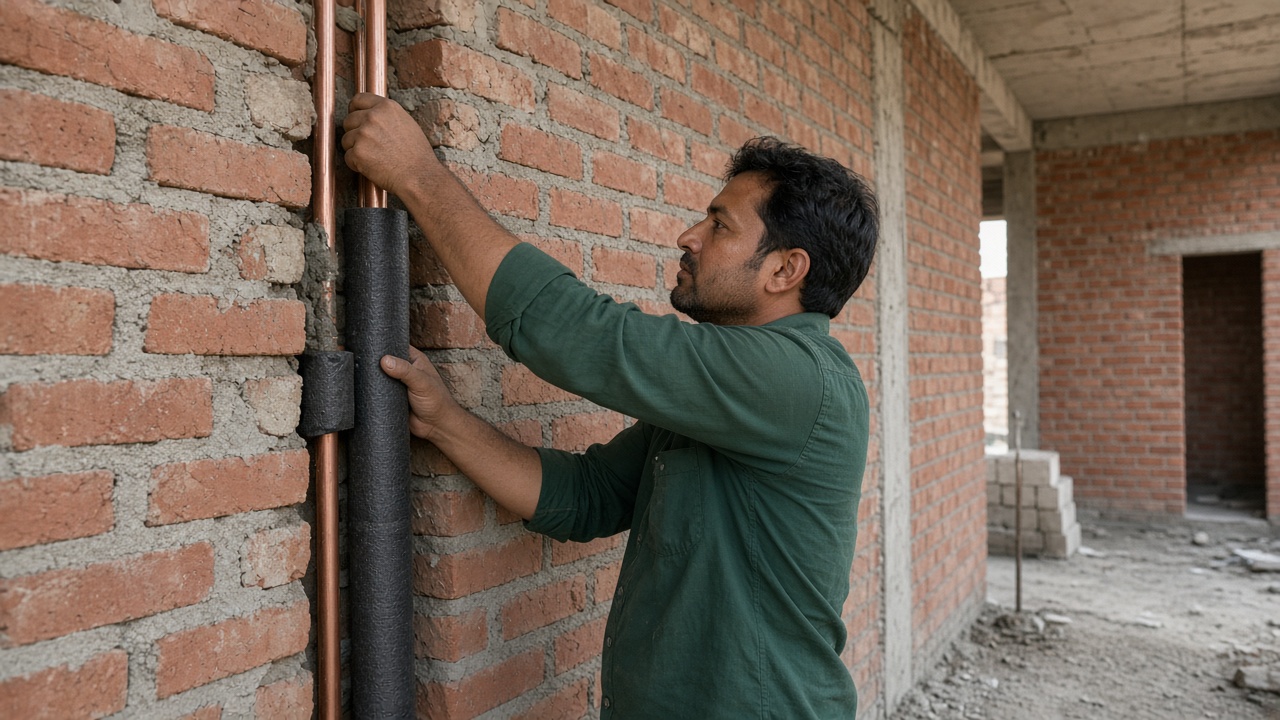
The job is an insulated copper pair sized to the future tonnage, a drain with continuous fall to a wet stack or an outside drop, and an electrical sleeve for the indoor-outdoor interconnect. We pressure-test before the mason closes the chase. A crushed bend or an uninsulated suction line inside a wall is a future leak you will not see.
Tell us bedroom count and which walls will take indoors. We mark outdoor locations that still have air and a ladder path after the elevation is finished — a common miss on tight DHA Phase 4 sides.
This is construction-stage work. We coordinate with your electrician for the isolator point. We do not plaster. After handover, book a separate installation when the machines arrive.
If a builder already buried pipe and the new AC will not hold vacuum, we camera or pressure-test what we can and tell you honestly whether to open the wall or run surface copper.
Questions we get on this job
When should copper go in?
After brickwork, before plaster and false ceiling. Drain fall is impossible to fix cleanly after pop.
Do you supply the copper?
Yes, insulated pair, fittings, drain, and sleeve. You can supply copper if you insist on a brand; we still test it.
Can you pipe a house already painted?
We can, but it will not be concealed. That becomes a surface install or a chase-and-patch, quoted as such.
Is this only for splits?
High-wall splits are the usual Cool Planet job. Multi-indoor or long VRF-style runs are quoted after a site look — we do not pretend every villa is a 1.5 ton bedroom.